Trusted Partners
Top Installers in Richmond
HPCN-certified, 4+ stars, verified by Google. Browse and pick one.
Every rebate a Richmond homeowner can get in 2026 — heat pumps, solar, insulation, water heaters, EV chargers, and free income-qualified programs — explained plainly, with how each one works.
Updated July 2026 · Independent guide. We don't sell your info. Numbers below are money you keep (rebates), not loans.
Two quick questions — free, instant estimate, no sales calls.
Quick Win
Replacing a fridge, washer, cooktop, or smart thermostat? BC Hydro rebates $150–$500 on Energy Star models.
See all product rebates →Before You Call an Installer
Get a personalized estimate based on your home and current heating. Includes exact rebate amounts for Richmond.
Calculate My Savings →Trusted Partners
HPCN-certified, 4+ stars, verified by Google. Browse and pick one.
In 2026, a Richmond homeowner can claim up to $16,000 for a heat pump, $5,000 for solar panels, up to $5,500 for insulation, $1,000–$3,000 for a heat-pump water heater, and up to $550 for an EV charger. Stacked together, the rebates can total roughly $35,000.
Richmond runs on BC Hydro electricity and FortisBC gas. It's also one of the few BC cities that adds its own money on top of the provincial rebates — so you stack CleanBC, both utilities, the City's top-up, and federal money for lower-income households.
If your gas furnace is aging, the rebate math favors a heat pump. You'll claim $4,000–$16,000 (depending on income), plus local financing when available. Total rebate + financing can cover 50–70% of a new heat pump system—and you gain cooling, better resilience, and lower bills.
Replaces a gas furnace or electric baseboards. Income-qualified reaches ~$21,000 with electrical — and Richmond adds up to $2,000 more (below).
BC Hydro rebate. Roughly 11–14 year payback in Richmond after the rebate, faster as rates rise.
Up to $1,500 paired with solar, or up to $5,000 when enrolled in BC Hydro's Peak Saver program — and it keeps the lights on during outages.
Attic, walls, crawlspace. Usually the best first dollar you spend — it makes the heat pump smaller and cheaper.
Replaces a gas or electric tank. Amount depends on your utility and income.
ENERGY STAR windows and exterior doors that replace older, draftier units.
$350 for a home Level 2 charger, plus $200 for a power-management device that avoids a panel upgrade.
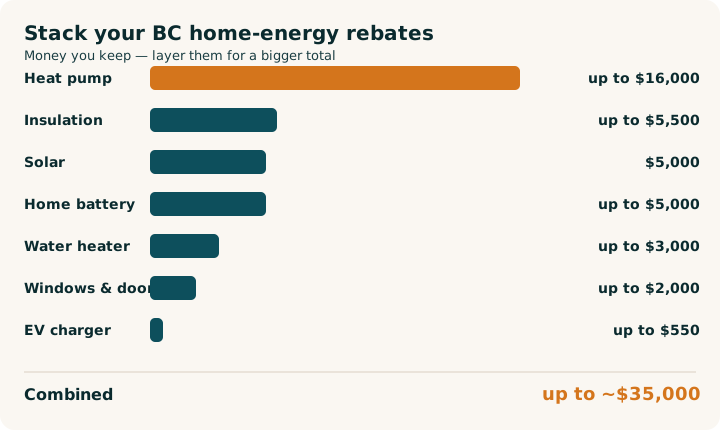
A typical household keeps $5,000–$16,000, plus Richmond's up-to-$2,000 heat pump top-up. A lower-income deep retrofit can stack toward $27,000–$32,000 in rebates you never repay.
The old federal "Greener Homes" $40,000 grant and loan are both closed as of late 2025. Any site still advertising them is out of date. The federal money that remains flows to lower-income households through the CleanBC programs below.
Storm-season outages are the real driver here. A home battery keeps your essentials — fridge, lights, internet, a heat-pump circuit — running when the grid drops, and BC Hydro pays up to $5,000 toward an approved one through Peak Saver. Solar's job in Richmond is mainly to recharge that battery through the day.
Backup through outages, plus the rebate. It must be on BC Hydro's approved list or you get $0 — the Tesla Powerwall doesn't qualify. Which batteries qualify →
At ~~3.5 sun hours, think of solar here as what tops up your battery through the day, not a fast-payback play on its own.
These are the backbone. They're the same whether you're in Richmond or anywhere else in BC — what changes is which utility runs them for you. Here's each program and how it works.
The centrepiece. A cold-climate heat pump both heats and cools your home using electricity instead of gas. Everyone gets a base rebate; lower- and middle-income households get much more.
Up to $5,500 for insulation (attic, walls, crawlspace) and up to $2,000 for ENERGY STAR windows and exterior doors. This is the "building envelope" — sealing the house before you size heating.
A heat pump water heater uses ~⅓ the energy of a standard electric tank. Replaces gas, electric, or oil tanks.
A rebate toward rooftop solar. Excess power you generate is credited back on your bill.
50% of cost up to $350 for a Level 2 home charger, plus $200 for an EV power-management device that lets you charge without an expensive panel upgrade.
Homes with electric-baseboard heating can get a free smart thermostat (a ~$350 value) starting fall 2026. At 300+ BC stores, instant in-store rebates knock $10–$200 off efficient products.
Once an eligible smart device is installed, enrolling it in Peak Saver pays a one-time bonus plus a reward every winter season — and for a home battery it's what unlocks the higher self-generation rebate.
A box of LED bulbs, a high-efficiency showerhead and other quick wins, mailed to your door to install yourself. Open to income-qualifying households.
The Energy Conservation Assistance Program sends an energy coach to your home and installs upgrades at no cost — which for qualifying homes can include a free heat pump, insulation, weatherization and ventilation.
Since most homes here also have a FortisBC gas account, you can tap Fortis rebates too: up to $4,000 for a heat pump ($1,500 partial), or up to $12,000 income-qualified, plus $5,000 for a dual-fuel (heat pump + high-efficiency gas furnace) system.
The replacement for the closed Greener Homes grant/loan. An $800M federal program for low-to-median income households, delivered in BC through the provincial CleanBC channels — covering insulation, heat pumps, windows and solar.
The heat pump rebate isn't one number — it scales with household income. These are the general CleanBC tiers; your exact amount is confirmed by the EnerGuide evaluation. The assessment tool estimates your tier in a minute.
Highest support
Plus possible free-install (ECAP) and federal Affordability top-ups.
Enhanced support
Sliding scale between the standard and lower-income amounts.
No income test
Every eligible BC household gets at least this for a qualifying heat pump.
BC Hydro (electricity) + FortisBC (gas)
~3.5 peak sun hours/day
Typical of the coast. Cloudy winters, productive summers — the annual math still works with the $5,000 rebate.
Mostly natural gas
Lots of older gas-heated homes — prime candidates for fuel-switching rebates.
Very reliable
Dense urban grid, generally reliable with occasional winter windstorm outages.
Richmond is one of the few BC cities that puts in its own money: the City matches the provincial heat pump incentive with up to an extra $2,000, on top of everything CleanBC and your utilities pay. It also publishes detailed green home retrofit guidance and a dedicated heat pump resource for detached homes.
Solar equipment is also exempt from the 7% provincial sales tax, and your excess generation is credited at 10¢/kWh.
Quote to installation: 8–12 weeks for solar, faster for a straight heat pump swap
Permits: City building permit + TSBC electrical permit
Interconnection (solar): 4–8 weeks
Rebate payout: typically 30–45 days after the paperwork is filed
Yes, though Richmond's ~3.5 peak sun hours are on the lower side thanks to cloudy winters. Summers are productive, and across a full year an 8–10 kW system still offsets a solid share of your bill — helped by the $5,000 rebate, PST exemption, and 10¢/kWh export credit.
An 8 kW system usually runs $25,000–$30,000 before rebates. After the $5,000 BC Hydro rebate (and PST exemption) your net is roughly $19,000–$24,000, paying back in about 11–14 years.
Richmond's many older gas-heated homes are prime candidates: CleanBC pays $4,000–$16,000, and the City adds up to $2,000 more. You also gain cooling for increasingly hot summers — a genuine health benefit in a heat dome.
Considerably more. The Energy Conservation Assistance Program can install a heat pump, insulation and weatherization for free, and the federal Affordability money flows through it. A family of four earning up to ~$57,200 can qualify. Start with the assessment or ask us and we'll point you to the income-qualified stream.
Renters can't claim the structural rebates (your landlord would), but the free energy-saving kit and smart-thermostat offers are open to you. In a strata, in-unit upgrades like a heat pump water heater or windows may qualify with strata approval; whole-building work goes through the strata council and a separate condo/apartment program.
Get quotes now and apply as soon as you've chosen an installer — the pre-upgrade evaluation has to happen before work starts, so late applications forfeit the rebate.
Rebates take a few weeks to line up. These cost little or nothing and start saving immediately — the dollar figures are BC Hydro's own estimates. See all of them in our full guide →
Door sweeps (~$9) and foam outlet gaskets (~$1 each) stop the leaks that make your heating work overtime. How-to →
Turning heat off in empty rooms automatically can save about $150 a year. A smart thermostat that drops to 16°C when you're out saves ~$55/yr. Smart devices →
Shift EV charging, laundry and the dishwasher to 11 p.m.–7 a.m. and avoid the 4–9 p.m. peak. Best for EV owners. See the rate →
Open south-facing blinds on winter days for free heat; close them at night to keep it in. Reverse in summer. Seasonal tips →
Wash in cold water, run full loads only, and insulate exposed hot-water pipes. Small habits, steady savings.
Replace filters yearly, hold a steady temperature, and use "heat"/"cool" not "auto." New to heat pumps? Read our explainer →
Real retrofit talk from locals on r/richmond — search "heat pump" or "solar."
City of Richmond heat pump & permits for solar and heat pump installs. Your installer usually files these for you.
The BetterHomes BC energy coach line answers rebate questions for free, province-wide.
Before you talk to anyone, get a free, no-spam estimate of exactly what you qualify for.
Estimate my rebates →Deep-dive guides and real-world comparisons to help you make the right choice.
Guide • Heat Pumps
Complete walkthrough of BC rebates, eligibility, installation, and what to expect post-install.
Guide • Solar ROI
Full breakdown of solar payback, 10-year savings, and ROI calculation.
Article • Cost
BC rebates cover 30-50% of costs. Here's the actual net cost after financing and savings.
Article • Comparison
Both qualify for the same rebates. Here's what differs.